For ABA leaders responsible for documentation defensibility
One Documentation Gap Can Cost Your Organization Hundreds of Thousands in an Audit
If you are responsible for session note quality, you don't have the luxury of assuming notes are probably fine.
Read the evidence ↓Recent OIG Audit Findings
64–96%
of ABA service months reviewed lacked sufficient documentation
$77.8M
estimated overpayments recovered through recoupment
When session notes are flagged under audit, the responsibility falls on you.
Not the clinician who wrote the note.
Not the billing team who submitted the claim.
You.
For leaders in this position, documentation oversight isn't theoretical. It's operational. It's financial.
The question isn't whether your organization could be audited.
It's whether your session notes will stand up under audit scrutiny.
Recent OIG Audit Activity
Federal and state audit activity targeting ABA services has increased markedly in recent years.
The OIG has initiated multiple audits examining Medicaid coverage and oversight of ABA services across states.
4 states
3 more states
Source: HHS OIG Work Plan
The findings were consistent:

64% to 96%
of ABA service months reviewed contained insufficient documentation
$18 million to
$77.8 million
in estimated overpayments to ABA providers
Payers recover those funds through formal recoupment demands,
often with interest
Payers have noticed something else
Auditing ABA providers is about
50% more profitable
than auditing other service types.
Which means organizations like yours aren’t being audited by accident.
They’re being targeted!
The financial consequences are already on record
$360,000
One organization paid $360,000 in an ability-to-pay settlement–meaning the financial exposure exceeded what they could afford
$675,000
An ABA provider agreed to pay $675,000 after documentation could not substantiate billed CPT codes
$2.5 million
Two autism services providers paid a combined settlement to resolve findings tied to services that were not properly documented
$2.7 million
Nine locations of a single ABA provider paid after medical records failed to substantiate billed services
In each case, the services were delivered. The session notes
couldn’t substantiate the billed services when audited.
The issue isn't clinical quality. It isn't supervision.
It isn't your internal review process.
It's that none of those systems were built around how payers evaluate session notes under audit.
That's a different standard — and it requires a different approach to documentation.
The Evaluation Gap
Your Clinical Team Says the Note Is Good.
The Payer's Reviewer Disagrees.
Here's Why.
Under audit, only one set of criteria determines whether your claim gets paid or
becomes subject to recoupment.
When Your Team Reviews a Note
- Was the intervention implemented correctly?
- Were treatment goals addressed?
- Is the session narrative complete?
- Does this reflect sound clinical care?
When a Payer Reviewer Examines It
- Does the documentation independently support the billed CPT code?
- Are all the required service elements clearly documented?
- Is medical necessity explicitly supported in the record?
- Would this documentation stand on its own under audit scrutiny?
Your clinicians can answer yes to every question on the left
— and still fail every question on the right.
The reviewer has no clinical context. Just the note, the CPT code, and a checklist.
If the note doesn't satisfy that checklist on its own — the claim is indefensible.
That’s the standard your documentation is already being measured against.
What We Find When We Audit ABA Session Notes Against
Compliance Standards
Across payer audits and internal reviews, the same documentation gaps appear consistently.

Session notes don’t substantiate the billed CPT code
The service was delivered.
The note doesn’t independently demonstrate the required service elements.
The claim can’t be defended.
Units of time billed exceed what the medical record supports
The session occurred.
The note can’t justify the billed units.
The excess is flagged for recoupment
Services documented in a way that doesn’t meet payer requirements
Clinical activity is recorded. Without CPT-aligned structure, the note doesn’t independently support the billed service under audit review.

Each of these gaps has resulted in repayment demands against ABA providers.
Documentation gaps don't stay contained.
With scale, they multiply — and are uncovered under audit.
When uncovered, they require time, correction, and formal response
— shifting focus from growth to remediation.
We've Managed the Payer Reviews.
We Know Exactly Where the Gaps Are.

Michael Fabrizio

Rose Feddock
55+
Combined years of ABA practice
10+
Years each in ABA healthcare compliance
That experience produced one consistent finding:
documentation gaps rarely stemmed from poor clinical care.
They stemmed from the absence of a shared standard for how documentation is evaluated under CPT and reimbursement criteria.

“Michael and Rose are two of the smartest and most experienced clinicians in our field. Do not pass go. Do not collect $200 without their advice.”
—Molly Ola Pinney - ABA Business Coach
The ABA Session Note Frameworks were built
to close that gap.
The session note alignment gap is a structural problem.
It has a structural solution.
Every finding on this page points to the same root cause — session notes not built around how payers evaluate them under audit. That's a fixable problem. But the fix requires something different from clinical training, supervision, or internal review alone.
It requires a shared CPT-aligned documentation standard — one that every clinician, supervisor, and compliance reviewer in your organization works from. One built around the same criteria a payer applies when they audit your records.
That is what the ABA Session Note Frameworks are.
One standard. Every clinician. Every role. Every audit.
Built around the same criteria payers apply when they review your records.
ABA Session Note Frameworks are short, on-demand video courses — one per CPT code — designed to establish a shared documentation standard across your organization
without interfering with your clinical model.
Each ABA Session Note Frameworks defines:
- What the CPT code permits and requires
- What the documentation must reflect to support the billed service
- How payer reviewers evaluate notes under audit scrutiny
- How to distinguish billable therapeutic intervention from non-billable activity
- How to ensure billed services align with CPT scope
Here is what you get as part of
BCBA Bundle Frameworks
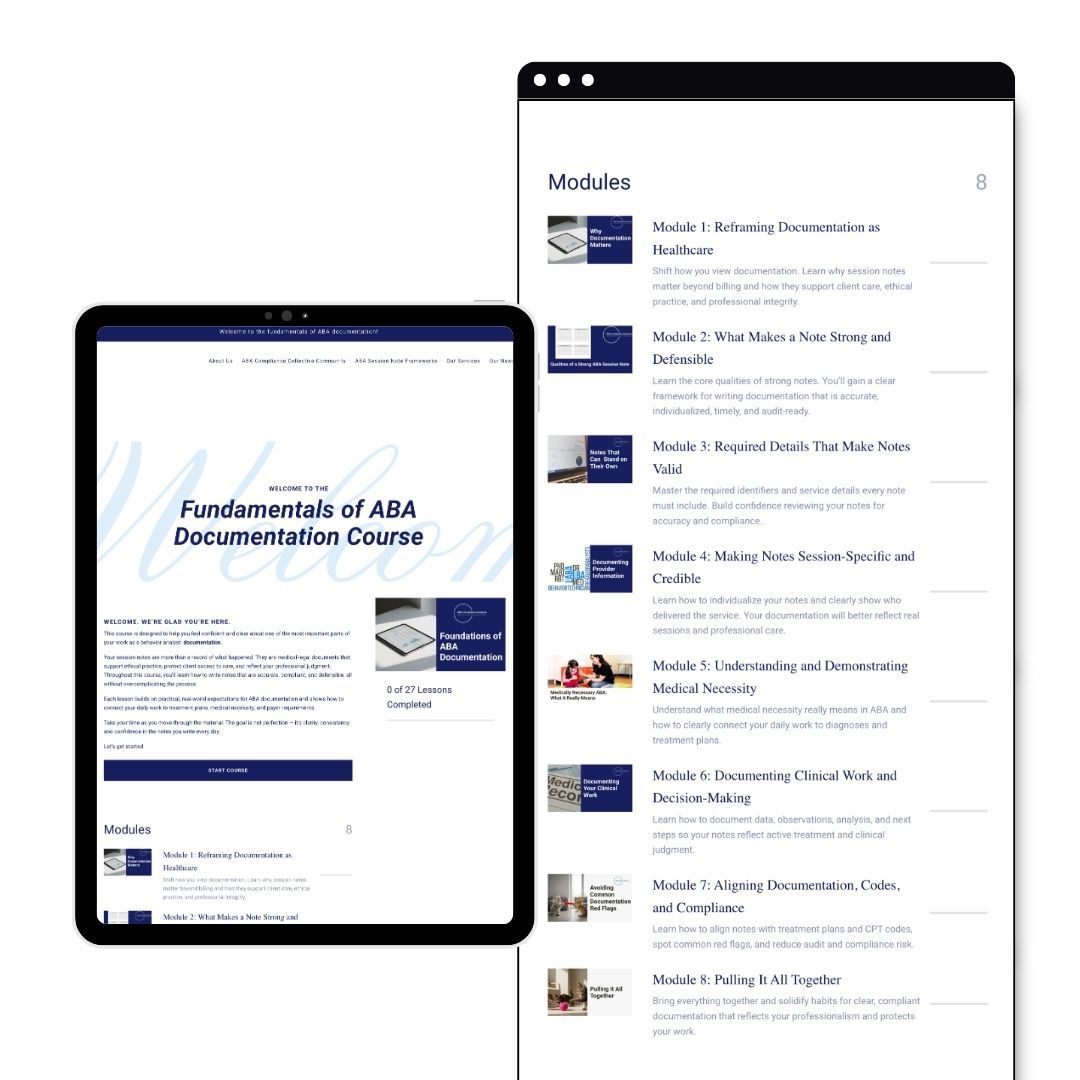
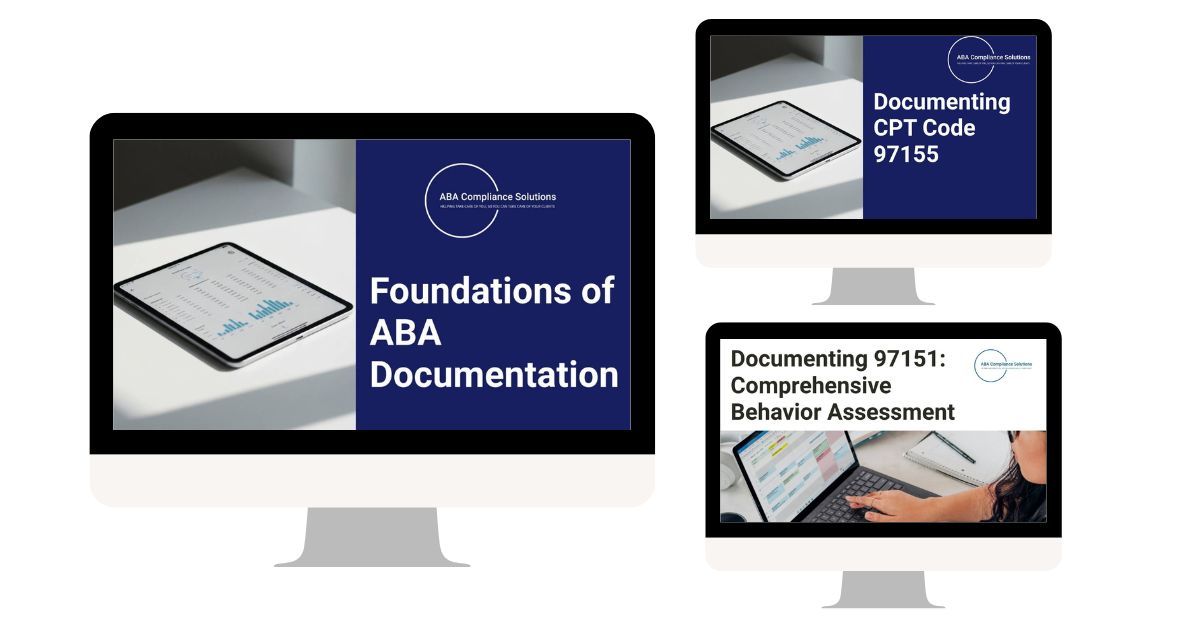
1) The Foundations of ABA Documentation
Right now, documentation across your organization is shaped by individual habits, training backgrounds, and supervisor preferences. Your team may be documenting what happened in session—but not in a way that consistently justifies what was billed. That gap is where audits, denials, and recoupments occur.
The Foundations of ABA Documentation framework teaches your organization how to align clinical documentation with billing requirements—so your notes don’t just describe care, they defend it.
Get CPT-Aligned Documentation StandardsYour team will learn how CPT codes, medical necessity, and payer expectations define what must be present in every session note.
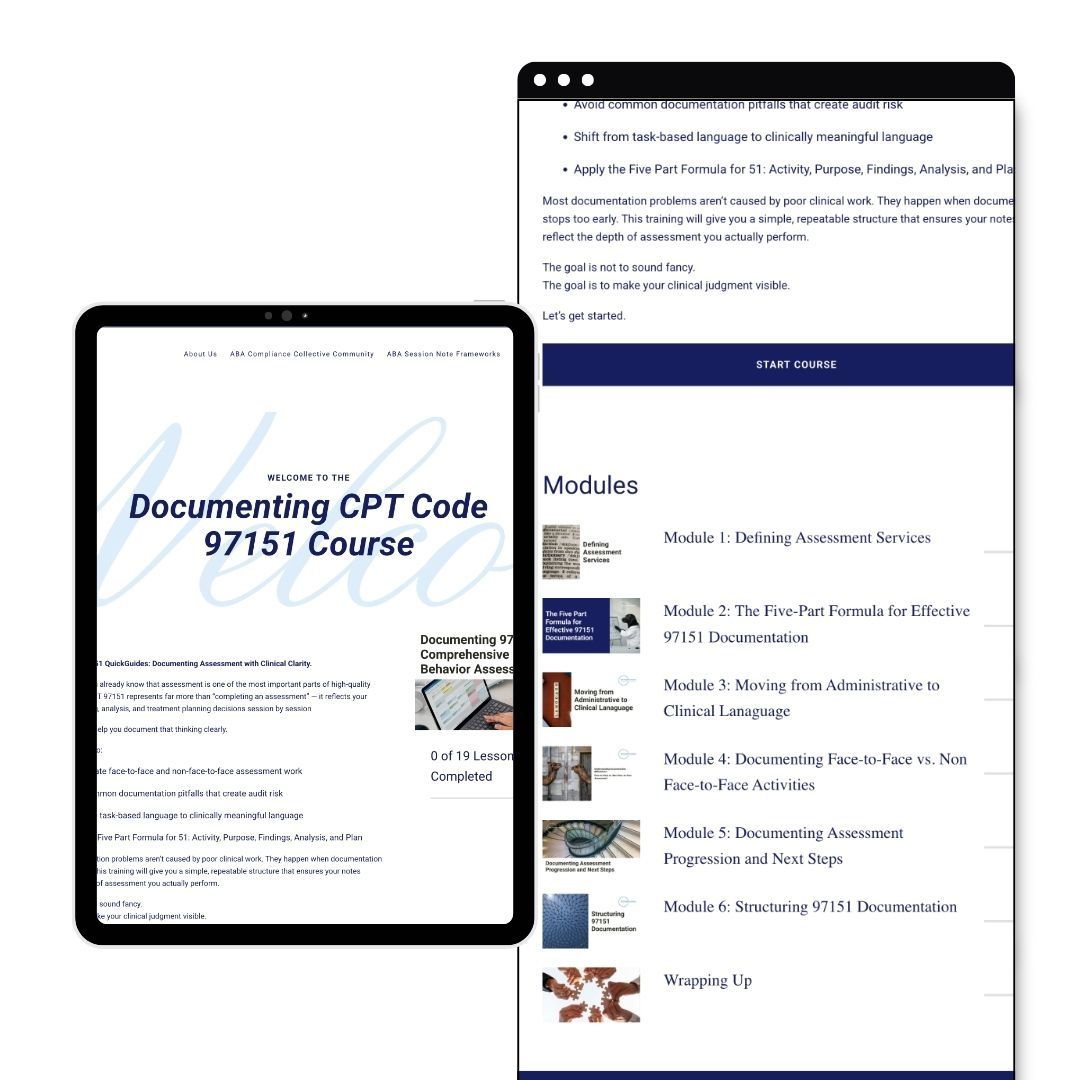
2) Documenting CPT code 97151
Assessment session notes often read as a summary of activities completed—rather than a clinical service that justifies medical necessity and the time billed. The final treatment plan is not a substitute for solid assessment session notes and won’t protect you in an audit.
The 97151 framework helps your organization align assessment notes with billing requirements—so your notes stand on their own to support what’s billed.
Get CPT-Aligned Documentation StandardsYour team will learn how assessment activities, data analysis, and clinical interpretation must all be reflected in the session note—not just the final report.
3) Documenting CPT code 97155
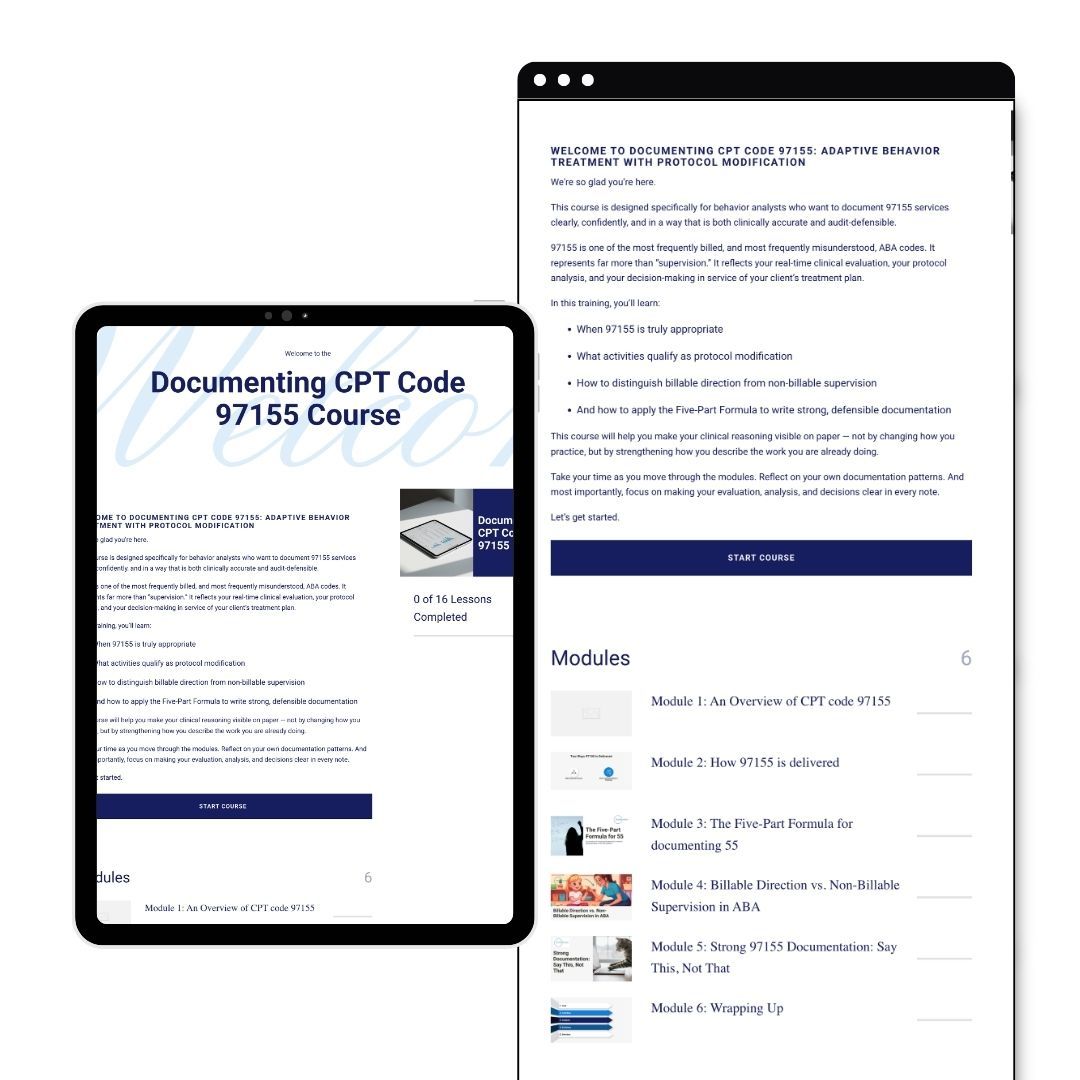
97155 requires more than documenting that a supervisor was present or that changes occurred. It requires documentation of the clinical analysis and decision-making driving those changes—something many notes don’t consistently capture. In an audit, that lack of specificity puts the service at risk.
The 97155 framework helps your organization document protocol modification services in a way that aligns with CPT requirements—so your notes reflect the clinical reasoning, not just the activity.
Get CPT-Aligned Documentation StandardsYour team will learn how to document observations, analysis, and real-time decision-making in a way that holds up under audit.
4) Documenting CPT code 97156
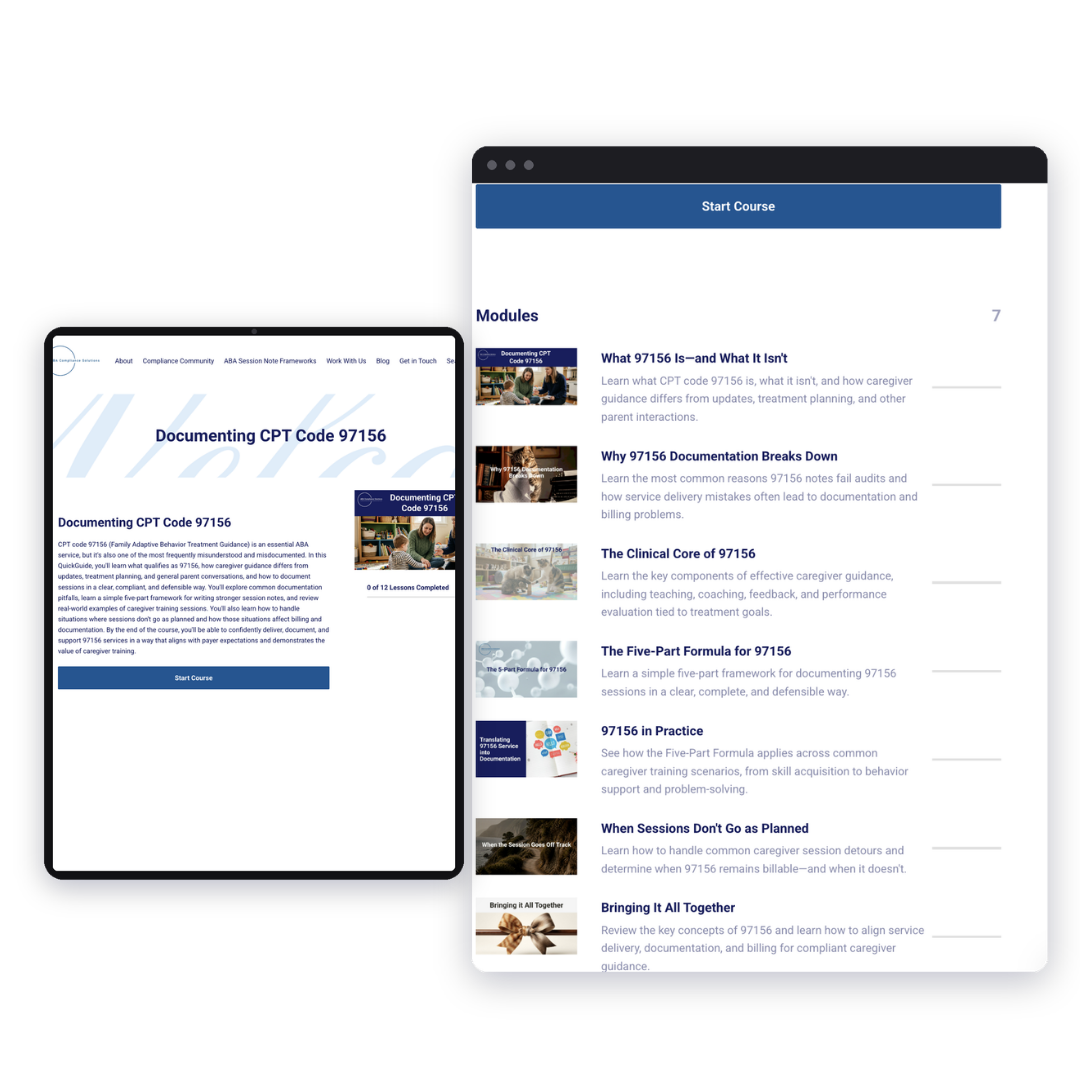
Family guidance notes often record that a caregiver meeting occurred, or that “parent training” was provided, without showing the clinical work that makes the service billable. When a note reads as general education or a status update, it doesn’t demonstrate that the guidance targeted the client’s treatment goals. That gap is exactly what auditors flag for recoupment.
The 97156 framework helps your organization document family guidance so the note reflects skill-building tied to the client’s plan, not just a conversation with the caregiver.
Get CPT-Aligned Documentation StandardsYour team will learn how to distinguish billable family guidance from non-billable parent education, and how to capture the caregiver’s response and the clinical direction in every session note.
Here is what you get as part of
Behavior Technician Frameworks
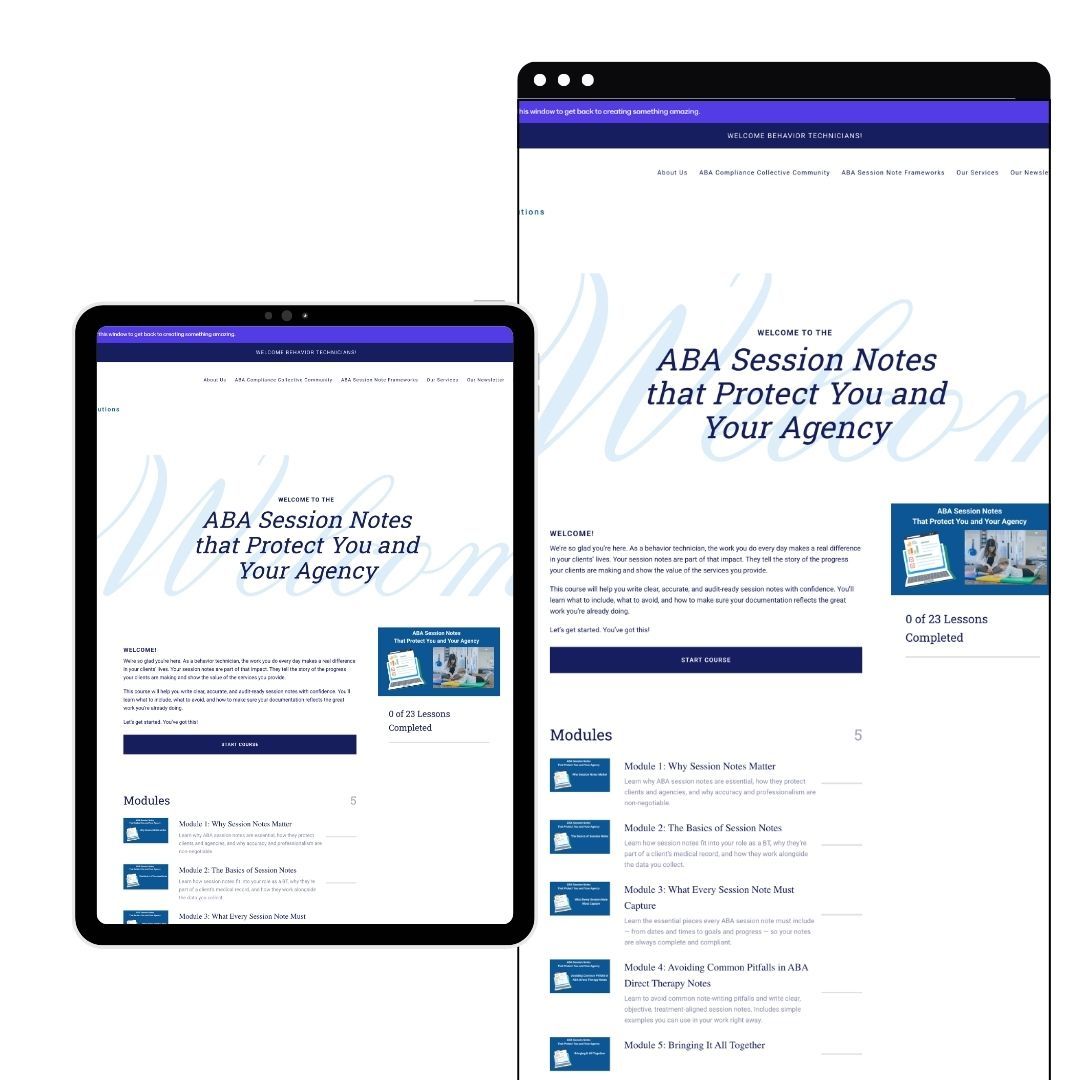
BT session notes often underrepresent the service being billed. Sessions may run three or more hours—but the documentation reads as a simple summary of activities, not a billable clinical service.Notes often include language that suggests childcare rather than treatment, and are written as if the audience is the BCBA—not the payor. In an audit, these gaps put the entire service at risk.
The BT Documentation frameworks help your team shift how they think about session notes—so documentation clearly reflects the treatment provided and supports what’s billed.
Your team will learn how to describe session activities in clinical, objective terms, connect their work to the treatment plan, and write notes that stand on their own as part of the medical record.
The ABA Session Note Frameworks Don't Replace Your Existing Systems.
They Give Them a CPT-Aligned Standard to Work From.
The ABA Session Note Frameworks are designed for immediate use.
No implementation project. No system overhaul. No disruption to existing clinical or supervisory workflows.
Organizations typically integrate them in one of three ways:

Onboarding
New clinicians and technicians complete the relevant Session Note Framework before documenting billable services — establishing CPT-aligned documentation expectations from day one

Supervision
Supervising behavior analysts use the Session Note Frameworks as a shared reference point during documentation review and feedback — replacing subjective evaluation with clear, defined criteria

Internal Audit
Compliance and leadership teams align internal review processes with the same standards payer reviewers apply — so internal audit findings reflect external audit risk
This ensures clinicians, supervisors, and internal reviewers
are working from the same documentation standard from the beginning.
For multi-site organizations and larger providers, scaled licensing
and LMS integration options are available.
Most organizations begin with one role and expand from there — embedding the Session Note Frameworks into existing systems as documentation consistency improves.
Align Your Documentation Standard TodayThis Is the Difference Between Notes That Get Paid
and Notes That Get Questioned
The gap between a note that stands up under audit scrutiny and one that doesn't is rarely about clinical quality. It's about what the documentation explicitly reflects.
These examples reflect documentation patterns we routinely encounter when auditing ABA session notes against CPT standards.
CPT 97151 — Behavior Analytic Assessment
45-minute session
BEFORE — Insufficient Under Audit Review
"Interview with client's guardian by telehealth."

AFTER — CPT-Aligned Documentation
"Interviewed client's guardian to begin to identify family priorities for the client's initial ABA treatment plan. Guardian indicated that they would like to see the client engage in expanded play (specifically interactive play with their siblings) and be able to attend church services and other functions in the community that require the client to wait relatively quietly for up to 30 minutes at a time. Goals addressing these areas of concern will be added to the client's initial ABA treatment plan."
CPT 97155 — Technician Direction and Protocol Modification
90-minute session
BEFORE — Insufficient Under Audit Review
"I observed the client and their behavior technician. Behavior technician implemented all programs with fidelity. No protocol modification required."
AFTER — CPT-Aligned Documentation
"I assessed the client's performance across 7 programs from their treatment plan being implemented by the behavior technician. The BT implemented each program with very good procedural fidelity. Of the 7 programs assessed, I directed the BT on introducing new stimuli and targets for 4 of the programs, I determined that 2 of the protocols were functioning as desired and no change was needed at this time, and 1 of the client's programs required an intervention due to the client not making adequate progress. For that program, I modified the prompting procedure the BT was using. Specifics of each protocol modification were noted on each program's accompanying graph."
The before notes document what occurred.
The after notes substantiate what was billed.
That distinction is what audit scrutiny is built around.
Get CPT-Aligned Documentation StandardsWhat Leaders Ask Before Implementing the ABA Session Note Frameworks —
and Our Direct Answers
We already train our staff.
Our behavior analysts audit notes.
We use AI or automated review tools.
We've never been audited or had payments denied.
We passed our last audit.
The ABA Session Note Frameworks
Are the Right Fit If
Any of These Describe Your Organization

Your organization:
- Provides strong clinical services but still sees documentation flagged under audit or payer review
- Has internal documentation review processes that feel inconsistent or rely on subjective judgment
- Wants to reduce documentation risk without changing its clinical model or adding operational complexity
- Is preparing for growth, additional payer scrutiny, or standardization across multiple sites
- Has received a records request or audit finding and wants to address documentation alignment proactively

It may not be the right fit if your organization:
- Needs immediate corrective action support in response to an active audit — in that case, direct compliance consulting is a more appropriate first step
- Is looking for service delivery training rather than documentation guidance
If your organization is in the first group,
here's where to start
Get CPT-Aligned Documentation Standards
If You're Responsible for Documentation
Outcomes, This Is Your Next Step.
Enforcement actions tied to documentation deficiencies have resulted in repayment demands ranging from $360,000 to $2.7 million — against organizations delivering clinically appropriate services. Addressing documentation alignment now is significantly less disruptive than responding after reimbursement has already been challenged.
For BCBAs and supervisory roles
$197
Per Seat
Behavior Analyst Bundle
Includes:
- ABA Documentation Basics
- CPT 97155 Technician Direction and Protocol Modification Documentation
- CPT 97151 Comprehensive Assessment Documentation
- CPT 97156 Parent Training Documentation
For organizations standardizing documentation at the technician level.
$47
Per Seat
Behavior Technician Course
Includes:
- CPT 97153 Individual Direct Treatment Documentation
- CPT 97154 Group Direct Treatment (coming soon)
Get CPT-Aligned Documentation Standards
For organizations standardizing documentation at the technician level.
$47
Per Seat
Behavior Technician Course
Includes:
- CPT 97153 Individual Direct Treatment Documentation
- CPT 97154 Group Direct Treatment (coming soon)
Immediate access. Self-paced. Designed to be completed in under two hours.

"The course is very well organized with clear examples of what to do and what not to do. It tied each piece of the training together in a way that's easy to understand, and I loved how the modules were short and concise."
— Jessica Doll, BCBA & Owner, Pinnacle ABA Services

ABA Compliance Solutions saved my company from closure after a bad experience with an incompetent billing company. They were easy to work with, knowledgeable and ready to help in any way they could.
— Amber Lynn Kennedy, Pivot ABA
Organizational & Enterprise Access
Large ABA providers often use the ABA Session Note Frameworks to establish a single CPT-aligned documentation standard across multiple sites, ensuring clinicians, supervisors, and compliance reviewers evaluate documentation using the same criteria organization-wide.
Schedule a Conversation →
Join Our Free Trial
Get started today before this once in a lifetime opportunity expires.